Introduction
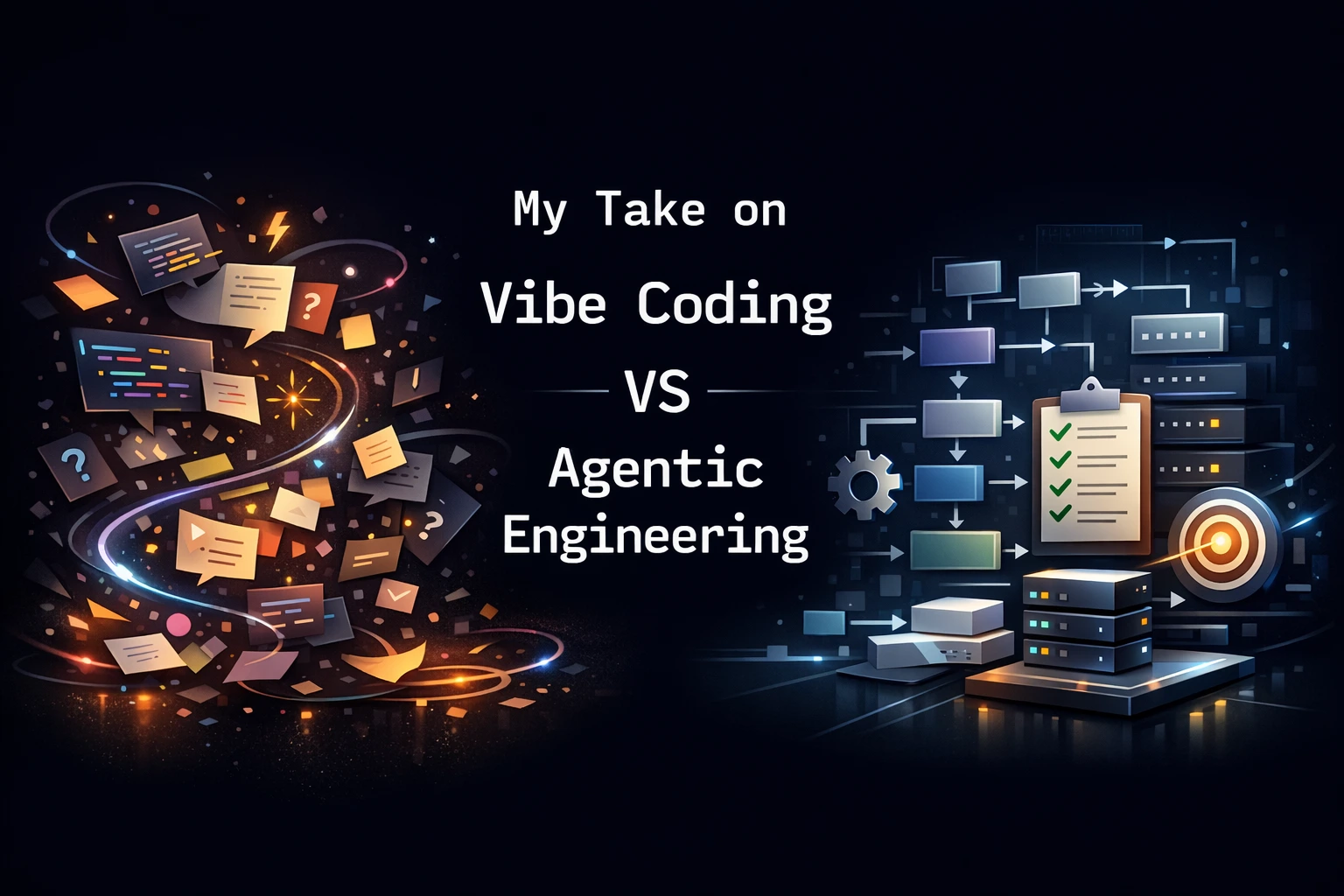
If you spend some time around AI, coding assistants, and developer discussions, you'll probably hear two styles of building software being mentioned a lot: Vibe Coding and what I like to call Agentic Engineering.
At first glance, both can look similar because in both cases you're using agents, prompts, and a lot less manual typing. But in practice, they lead to very different results.
In this article, I want to share my take on both approaches, explain why I believe Agentic Engineering is the right path for serious software development, and show you the workflow I usually follow when working with agents on real projects.
What is Vibe Coding?
For me, Vibe Coding is when you build software mostly by instinct, speed, and momentum.
You have an idea, open your editor, start prompting an agent, copy some code, adjust a few things, prompt again, and keep going while everything feels like it's working. The process is driven more by energy and immediacy than by structure.
This approach can feel great in the beginning because it gives you very fast feedback. You ask for a feature, the agent generates something, and in a few minutes you have a screen, an API, a command, or a test. That speed is exciting.
The problem is that speed without structure creates debt very quickly.
When you stay in Vibe Coding mode for too long, a few things usually start to happen:
- Requirements are fuzzy or keep changing in the middle of implementation.
- The design of the solution is discovered too late.
- Classes and responsibilities become messy.
- Tests are either missing or added just to make the pipeline green.
- The agent starts optimizing locally instead of solving the whole problem correctly.
In other words, Vibe Coding is great at producing output, but not always great at producing good software.
And to be fair, I don't think Vibe Coding is useless. It can be fine for:
- quick prototypes
- throwaway experiments
- validating an idea fast
- learning a new API or framework
But when we are talking about software that needs to be maintained, reviewed, extended, tested, and deployed with confidence, then we need something better.
What is Agentic Engineering?
Agentic Engineering is the practice of using AI agents as part of a deliberate engineering workflow instead of using them as a slot machine for code generation.
The key difference is that the agent is not the process. The agent is a tool inside the process.
With Agentic Engineering, we don't start by asking an agent to "build the thing". We start by defining what the thing is, what constraints exist, what architecture makes sense, what order the work should happen in, and how we are going to validate the result.
Then, and only then, we use agents to accelerate the execution of that work.
This changes everything.
Instead of just asking for code, we ask for:
- requirement refinement
- implementation planning
- scoped execution
- validation against requirements
- independent code review
That is why I like the term Agentic Engineering. The focus is still on engineering. The agent helps with planning, execution, and review, but the workflow remains grounded in software design, quality, and accountability.
In practice, this approach makes the agent much more useful because it has clearer constraints, clearer goals, and a better context to operate in.
Why We Should Follow Agentic Engineering Instead of Vibe Coding
The main reason is simple: software engineering is not only about producing code, it's about producing reliable change.
Vibe Coding optimizes for immediate output. Agentic Engineering optimizes for correctness, maintainability, and confidence.
When you follow an Agentic Engineering workflow, you get a few very important benefits.
First, you reduce ambiguity early. A requirements file forces you to think before implementation. That alone prevents a lot of bad decisions.
Second, you improve the quality of the generated code. Agents perform much better when they receive structured input and a clear execution plan.
Third, you make reviews easier. If there is a plan, a reviewer can compare the implementation against the requirements instead of reviewing code in a vacuum.
Fourth, you make the process repeatable. This is huge. A good workflow should not depend on you being in the perfect mood, having the perfect prompt, or getting lucky with the first response from the agent.
And finally, you keep the human in the right position: as the engineer responsible for the system, not as someone supervising a stream of random generated code.
This is the part that matters the most to me.
I don't want agents replacing engineering discipline. I want them amplifying it.
My Agentic Engineering Workflow in Practice
Now let me show you the workflow I usually follow and apply it to a real-world example.
Let's imagine I need to build a new feature for a SaaS application: a subscription billing retry system. The feature should:
- detect failed subscription renewals
- retry payments with configurable backoff rules
- notify customers by email
- expose the current retry state in the admin panel
- keep the whole flow tested and observable
This is exactly the kind of feature that can become messy very fast if you just start prompting an agent with "build me a billing retry system".
So instead of going into Vibe Coding mode, I follow this workflow.
Step 1: I create a REQS.md file
This is where everything starts.
Before asking the agent to implement anything, I write a REQS.md file with the functional requirements and the technical direction I want to follow.
That file usually includes things like:
- business requirements
- constraints and edge cases
- object/class tree or graph
- implementation order
- test suites that need to exist
- integration points
- things that should explicitly be avoided
For this subscription retry feature, part of the file could look like this:
# REQS

Feature:
Implement subscription payment retry flow for failed renewals.

Core Requirements:
Failed renewals must create a retry record.
Retry attempts must follow configured backoff intervals.
Customers must receive email notifications after each failed retry.
Admin panel must show current retry state and next scheduled attempt.

Domain Design:
Subscription
PaymentAttempt
RetrySchedule
RetryPaymentAction
NotifyCustomerAboutFailedPaymentAction
RetryPaymentJob
BillingRetryService

Implementation Order:
1. Database changes
2. Domain actions/services
3. Queue job orchestration
4. Notifications
5. Admin panel integration
6. Feature tests
7. Observability/logging

Test Suites:
Feature tests for retry scheduling
Feature tests for notification flow
Unit tests for backoff calculation
Integration tests for queue/job flow
With this, the agent is no longer guessing what I want. It has a clear target.
Step 2: I ask an agent in Plan mode for a detailed implementation plan
Once the requirements are documented, I give the REQS.md file to an agent and ask it to create a detailed, step-by-step implementation plan.
Not code. A plan.
This is a very important distinction.
At this stage, I want the agent thinking about sequencing, dependencies, risks, validation points, and how to break the work into safe increments.
For the subscription retry feature, I would expect a plan that says things like:
- create the retry persistence model first
- define the retry state transitions
- implement backoff calculation in isolation
- add the queued job only after the domain services are stable
- write tests around retry rules before wiring notifications
That type of plan is much more valuable than jumping directly into code generation.
Step 3: I refine the plan for 2 or 3 rounds
Usually the first plan is not perfect, and that's fine.
I refine it with the agent until the order makes sense, the scope is right, and the validation steps are good enough. In most cases, after 2 or 3 rounds, the plan is solid.
This is where a lot of hidden issues appear early.
Maybe the agent forgot a migration detail. Maybe the admin panel depends on state that does not exist yet. Maybe a job was introduced too soon. Maybe one test suite is missing.
Finding these issues during planning is much cheaper than finding them after 15 generated files.
Step 4: I start a new agent with clean context to execute the plan
Once the plan is approved, I start a new agent with clean context and ask it to work strictly from the plan.
I like using a clean context here because it reduces noise and keeps the execution focused.
The execution agent should not be improvising architecture. That work was already done. Its job is to implement the planned steps as cleanly as possible.
For our example, that means the agent can now:
- create the migration for retry tracking
- implement the retry service and actions
- add the queued retry job
- wire notifications
- write the planned tests
Now the speed of AI starts helping in the right way, because the work is constrained by a real engineering process.
Step 5: I ask another clean-context agent to validate requirements, plan, and code review
After implementation is done, I ask another agent with clean context to review three things together:
- the original requirements
- the approved plan
- the generated implementation
This is one of the most valuable parts of the workflow.
A fresh agent is much better at spotting gaps because it is not emotionally attached to the code it just created. It can compare expectations versus reality more objectively.
For the billing retry feature, this review might catch things like:
- missing coverage for the final retry failure path
- a notification being sent before state persistence
- admin panel data causing an N+1 issue
- a backoff rule not matching the documented requirement
That kind of feedback is exactly what we want.
Step 6: I do my own code review and refine things
No matter how good the agents are, I still do my own review.
This is where I check naming, class responsibilities, readability, framework conventions, test quality, and whether the implementation actually feels good to maintain.
This step matters because engineering judgment is still ours.
Sometimes the code is technically correct, but the design is not elegant. Sometimes the tests pass, but the boundaries are wrong. Sometimes the implementation follows the plan, but the plan itself needs a final human adjustment.
That final review is where I make sure the result is not only functional, but also something I would be happy to keep in production.
Step 7: I ask the agent to commit and create a PR if needed
Once everything is in a good place, I ask the agent to commit the changes and create a PR if needed.
At this point, the agent is helping with the operational side of delivery, not only with code generation.
And this is another reason I like this workflow: the agent participates in the full software delivery loop, but always inside a structured process.
Conclusion
My issue with Vibe Coding is not that it is fast. My issue is that it often confuses fast output with real engineering progress.
For prototypes, experiments, and quick spikes, that can be fine. But for real applications, I believe we need a more disciplined approach.
That is why I prefer Agentic Engineering.
It gives us the speed benefits of AI without throwing away requirements, planning, architecture, testing, review, and accountability. It treats agents as powerful collaborators, but not as a replacement for engineering thinking.
If you're already using agents in your daily work, my suggestion is simple: stop starting with implementation, and start with structure. Write the requirements, build the plan, refine it, execute it with clean context, review it independently, and then do your own final pass.
With this, you'll probably generate less random code and a lot more reliable software.
I hope that you liked this article and if you do, don’t forget to share this article with your friends!!! See ya!